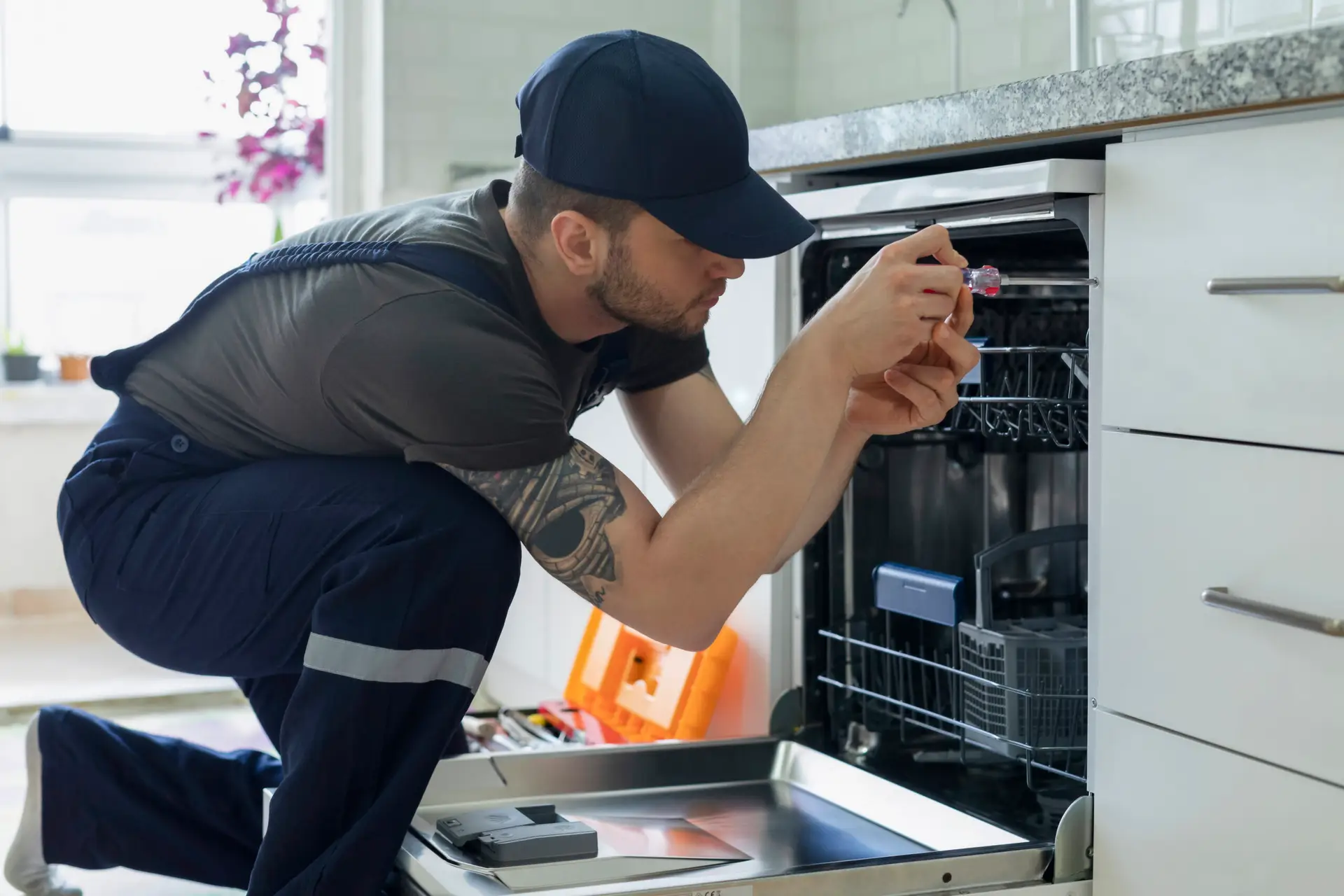
When a Miele dishwasher is not draining, the water is almost always stuck somewhere between the filters in the bottom of the tub and the drain connection under your sink. In most kitchens we visit, it turns out to be a clogged filter, a piece of glass or a fruit label jammed in the drain pump, a kinked hose behind the panel, or a blocked air gap or disposal connection, and only now and then a pump that has actually failed. Most of those are a single visit. Some of them you can check yourself in five minutes before you call anyone, and this page walks through them in the order we check them on site.
What the Display Is Telling You
A Miele that cannot pump out will stop the program and tell you so. Depending on the model and age, the display shows fault code F11 or a message asking you to check the drain, and on older machines without a text display a drain indicator lights up or flashes. Any of those means the same thing: the machine ran its drain pump and the water level did not drop the way it expected.
Water in the tub is different from water under the tub. If the dishwasher has shut itself off and the problem is water in the base pan, that is Miele’s leak protection doing its job, and the fix is finding the leak, not the drain. Our Miele appliance repair page lists the other fault codes we see on these machines, so you can tell which kind of problem you have before you call.
Start With the Filters
Every Miele dishwasher has a filter combination in the center of the tub floor: a coarse filter you can see, a fine filter around it and a filter plate underneath. Food, seeds, broken glass and a surprising amount of paper from jar labels collect there. When the filters clog, water drains so slowly that the machine gives up and reports a drain fault.
To check them, switch the dishwasher off, take out the lower basket, twist the filter handle and lift the whole assembly out. Rinse each part under the tap, look into the opening under it for anything stuck, then refit it until it locks. Make sure the filter plate sits flush. A filter that is not seated lets debris straight through to the pump, which is how a five-minute job becomes a service call.
The Drain Pump and Its Non-Return Valve
Under the filters sits the drain pump, with a small non-return valve that stops dirty water from running back into the tub. This is where the hard objects end up: shards from a broken wine glass, an olive pit, a twist tie, a fragment of a plastic lid. If you hear the pump humming or buzzing but nothing drains, something is usually blocking the impeller.
Miele designed the pump cover to be reachable from inside the tub, and on many models the owner’s manual shows how to lift it and clear it. Work carefully if you try it, because glass is the most common find. If the pump is clear and still will not move water, or if it makes no sound at all, the pump motor or its wiring has failed. That is a straightforward part replacement for our technicians, done with a genuine Miele drain pump.
The Hose, the Air Gap and the Disposal
If the inside of the machine is clear, the trouble is downstream. On a fully integrated Miele behind a custom panel, the drain hose runs through a tight cabinet space and can kink or get crushed when the unit is pushed back after an install or a cleaning. A hose that has been pinched for months often splits at the bend.
Many kitchens here have an air gap, the small chrome cap next to the faucet. When it clogs, water backs up or spills out of it onto the counter instead of draining. A new garbage disposal is another classic cause: the plug inside its dishwasher inlet has to be knocked out during installation, and when nobody does it, the dishwasher stops draining the very first day. A sink trap that is slow or blocked will also hold water in the dishwasher, so if the kitchen sink is draining slowly too, start there.
Hard Water and Detergent Build-Up
Los Angeles water carries a lot of minerals, and over time scale and detergent residue coat the sump, the pump housing and the inside of the drain hose. The opening gets narrower until a normal load of water takes too long to leave. Keeping the salt reservoir filled and the water hardness setting matched to your supply makes a real difference on a Miele. We wrote a separate guide to hard water damage in Los Angeles homes that covers the other appliances it affects.
Miele Dishwasher Problems We Fix Most Often
- Water left standing in the tub after the program ends
- F11 or a check-the-drain message stopping the cycle
- A drain pump that hums, buzzes or stays silent
- Broken glass or debris stuck under the filters
- Kinked or split drain hoses on integrated, panel-ready models
- Air gap and disposal connections that back up
- Slow draining from scale in the sump and hose
Each of these points to a short list of parts, and our technicians carry the common Miele drain parts on the truck so the repair is usually finished on the first visit.
Is a Drain Fault Worth Repairing?
Almost always, yes. Miele builds its dishwashers for a long working life, and a machine that will not drain still has a sound tub, spray arms and control system in nearly every case we see. The parts involved here, a pump, a valve, a hose or a cleaned sump, are small and specific. On a panel-ready model there is a second reason to repair: replacing the machine means fitting a new unit to cabinetry that was built around the old one.
What to Expect on Service Day
When you call, we ask for the model number, which on most Miele dishwashers is on a label along the inner edge of the door, and whatever the display is showing. That way the technician arrives with the right parts. On site, the technician runs the drain cycle, checks the filters, the pump and the hose path, and explains what failed and why. You get the quote before any work starts, and the inspection and the quote are free when you go ahead with the repair. If the cabinet panel has to come off, we protect the cabinetry and the floor before anything is moved.
Why Choose Us for Miele Dishwasher Repair
- Certified technicians who work on Miele dishwashers every week, including fully integrated models.
- Genuine Miele parts for pumps, valves and hoses.
- Same-day appointments on most days across Los Angeles.
- The quote before any work starts, so you decide before anything is replaced.
- Family-owned since 1980, with discounts for seniors, active military and veterans.
For dishwashers of every other brand, our main dishwasher repair in Los Angeles page covers the full service.
Frequently Asked Questions
Why won’t my Miele dishwasher drain?
The most common causes are clogged filters, debris in the drain pump, a kinked drain hose, or a blocked air gap or disposal connection. A failed pump motor is less common. Clean the filters first, since that solves a good share of cases on its own.
What does F11 mean on a Miele dishwasher?
F11 is Miele’s drain fault. The machine tried to pump out and the water level did not drop in time. It points to the drain path, from the filters down to the sink connection.
Is it safe to run the dishwasher with water standing in it?
It is better not to. Running it again usually ends in the same fault and can overwork the pump. Switch it off, check the filters, and call if the water is still there.
My dishwasher stopped draining right after a new disposal was installed. Why?
The knockout plug inside the disposal’s dishwasher inlet was probably never removed. It blocks the drain completely, and it is a quick fix once the hose is off.
Can you repair a Miele dishwasher the same day?
In most cases, yes. Call in the morning and we can usually get a technician to you that day with the common drain parts on board.
Contact Us for Miele Dishwasher Repair in Los Angeles
If your Miele is holding water or showing a drain fault, call 818-855-7988 and we will set up a visit, often for the same day, in homes from Encino and Sherman Oaks to Beverly Hills, Brentwood, Santa Monica and the rest of Los Angeles.