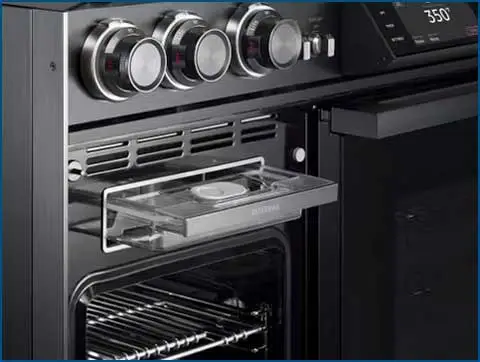
A Viking oven that will not heat, takes forever to preheat or swings twenty degrees either side of the dial almost always has one failed part behind it. On the gas models that part is usually the bake igniter: it still glows, but it no longer pulls enough current to open the gas safety valve fully, so the burner lights late, cycles off early, or never lights at all. On electric and dual-fuel Vikings the usual suspects are the bake element, the temperature sensor and the relay board. Each of those is a bounded repair our technicians do across Los Angeles every week.

Below is what each symptom usually means, which parts fail and what the visit looks like. If you would rather skip straight to booking, call 818-855-7988 and a certified technician can usually come the same day. For everything else we do on the brand, see the Viking appliance repair page.
Reading the Symptom
No heat, but the light and display work. On a gas model this is the igniter or the gas safety valve: the igniter glows for a minute and nothing happens, or it never glows. On an electric model it is a bake element that has gone open, often with a visible blister on the coil.
Slow preheat. If a 350 degree preheat that used to take twelve minutes now takes twenty-five, a weakening igniter is the first thing we test. On electric models it is a tired element or a sensor reading high.
Temperature swings and uneven baking. Cookies burnt on one sheet and raw on the next, or an oven thermometer that reads 320 one minute and 390 the next, usually mean the temperature sensor has drifted. On older Vikings with a mechanical thermostat, the thermostat itself is the suspect.
F-codes on the display. Viking’s electronic controls throw an F-code when the sensor reads open or shorted, when the door lock does not confirm, or when the board loses a relay. The code says where to look first; the circuit is still tested before anything is ordered.
The Parts That Fail on a Viking Oven
Viking built these ovens to be serviced, which is why a range from a 2004 remodel is usually still worth fixing. These are the components we replace most often.
- Bake igniter. A hot-surface igniter wears with every cycle until it glows without reaching the current the safety valve needs. It is the most common gas oven repair we do.
- Oven gas safety valve. When the igniter tests fine and the burner still will not light, the valve is sticking and is replaced as a unit.
- Temperature sensor or thermostat. A sensor reading a few hundred ohms off makes the control hold the wrong temperature without ever showing an error.
- Control board or relay board. Burnt relay contacts are the usual reason an oven heats on broil but not on bake, since each function has its own relay. Boards are tested before they are replaced.
- Convection fan motor. A squeal on convection bake, or a fan that has stopped, is the motor’s bearings drying out. It is a straightforward swap once the back panel is off.
- Door gasket and hinges. A door that does not close flush lets heat pour out of the top edge, so the oven runs constantly and bakes unevenly.
- Spark module on dual-fuel ranges. The surface burners share a spark module, and a failing one can take a burner position down and, on some models, upset the oven control too.
We carry genuine Viking parts for the common failures and tell you the lead time on anything that has to be ordered. If the rangetop is acting up too, our stove and range repair service covers burners, griddles and spark systems on the same visit.
How the Technician Finds the Fault
The technician confirms the symptom with you, reads any stored F-codes, and then the panels come off. On a gas oven the igniter is measured for current draw while it tries to light; Viking’s igniters have to pull a set amperage before the safety valve opens, and an igniter that glows but pulls well under that figure is the whole story. If the igniter passes, the valve is checked for voltage and flow. On an electric oven the element is measured for resistance and checked for a break to ground.
The temperature sensor is measured cold and compared with Viking’s chart, then the oven is run and its real cavity temperature is logged against the display across a full cycle, which is how a drifting sensor or a lazy thermostat gets caught. The door seal is checked all the way round. Only once the fault is pinned down does the technician write up the quote, so the repair is for the part that failed and not for a guess.
What the Visit Looks Like
When you call, we ask for the model number, which is on the data plate inside the oven door frame, and for what the oven is doing, so the technician can load the likely parts before leaving the shop. On arrival the technician diagnoses the oven, explains what failed and why in plain words, and gives you the quote before any work starts. Most igniter, sensor, element and fan repairs are finished the same visit because those parts are on the truck; a board or a valve may need ordering, and we return when it arrives. The cabinetry and the floor are covered before any panel comes off, and a full heat cycle after the repair confirms the reading matches the dial.
When to Stop Using the Oven
Most Viking oven faults are an inconvenience, and you can keep using the broiler or the rangetop until the technician arrives. Two exceptions. If you smell gas when the oven is off, or the smell lingers after the burner fails to light, shut the oven off, open a window and call us before using it again; a slow-lighting burner can let unburnt gas collect in the cavity. And if there is a burning smell from the control panel, a flickering display or an element that sparks, turn the oven off at the breaker and leave it off until it has been looked at.
Why Choose Us
Top Home Appliance Repair is a family-owned company that has been repairing kitchen appliances in Los Angeles since 1980. Our certified technicians fit genuine Viking parts and follow Viking’s own service procedures. You get the quote before any work starts, and the inspection and the quote are free when you go ahead with the repair. Seniors, active military and veterans get a discount. We are open 6 AM to 10 PM every day, with same-day appointments across most of our service area, and our repairs are affordable and reasonably priced.
Frequently Asked Questions
My Viking oven igniter glows but the burner will not light. Is it the igniter or the gas valve?
Most of the time it is the igniter. A glowing igniter looks healthy but may not be drawing enough current to open the safety valve. The technician measures the draw before replacing either part, because a valve is a bigger job.
Why does my Viking oven take so long to preheat?
A weak igniter is the usual answer on gas models: the valve opens late and closes early, so the oven creeps up to temperature. On electric models a worn bake element or a sensor reading high does the same. Either way it is a one-part repair.
Can a Viking oven be recalibrated instead of repaired?
Yes, if the oven is consistently off by a fixed amount, say 15 degrees low at every setting; Viking controls allow an offset adjustment. If the temperature swings, or the error changes from setting to setting, the sensor or thermostat is the problem and a calibration will not hold.
Is it worth repairing a Viking oven that is twenty years old?
Almost always. Viking ovens were built to be serviced across decades, genuine parts are still available for most Professional series models, and a single igniter, sensor or fan motor restores an oven the cabinetry was built around. When a unit has truly reached the end we say so and explain why.
How soon can someone come out?
Call in the morning and in most cases we can schedule a same-day visit in Los Angeles, the San Fernando Valley or the Westside. For Ventura County and the Orange County coast, tell us where you are and we will give you the earliest slot.
Contact Us for Viking Oven Repair in Los Angeles
If your Viking oven is cold, slow or cooking unevenly, call 818-855-7988 and tell us what it is doing. We repair Viking ovens in Encino, Sherman Oaks, Calabasas, Beverly Hills, Santa Monica and Malibu, across the San Fernando Valley and the Westside, and out to Ventura County and the Orange County coast. If yours is a different brand, our general oven repair service covers it, and the technicians who start the day near Encino reach the Valley first.